Connected Underwriting - Property & Casualty (P&C)
0-1 Solution
Context
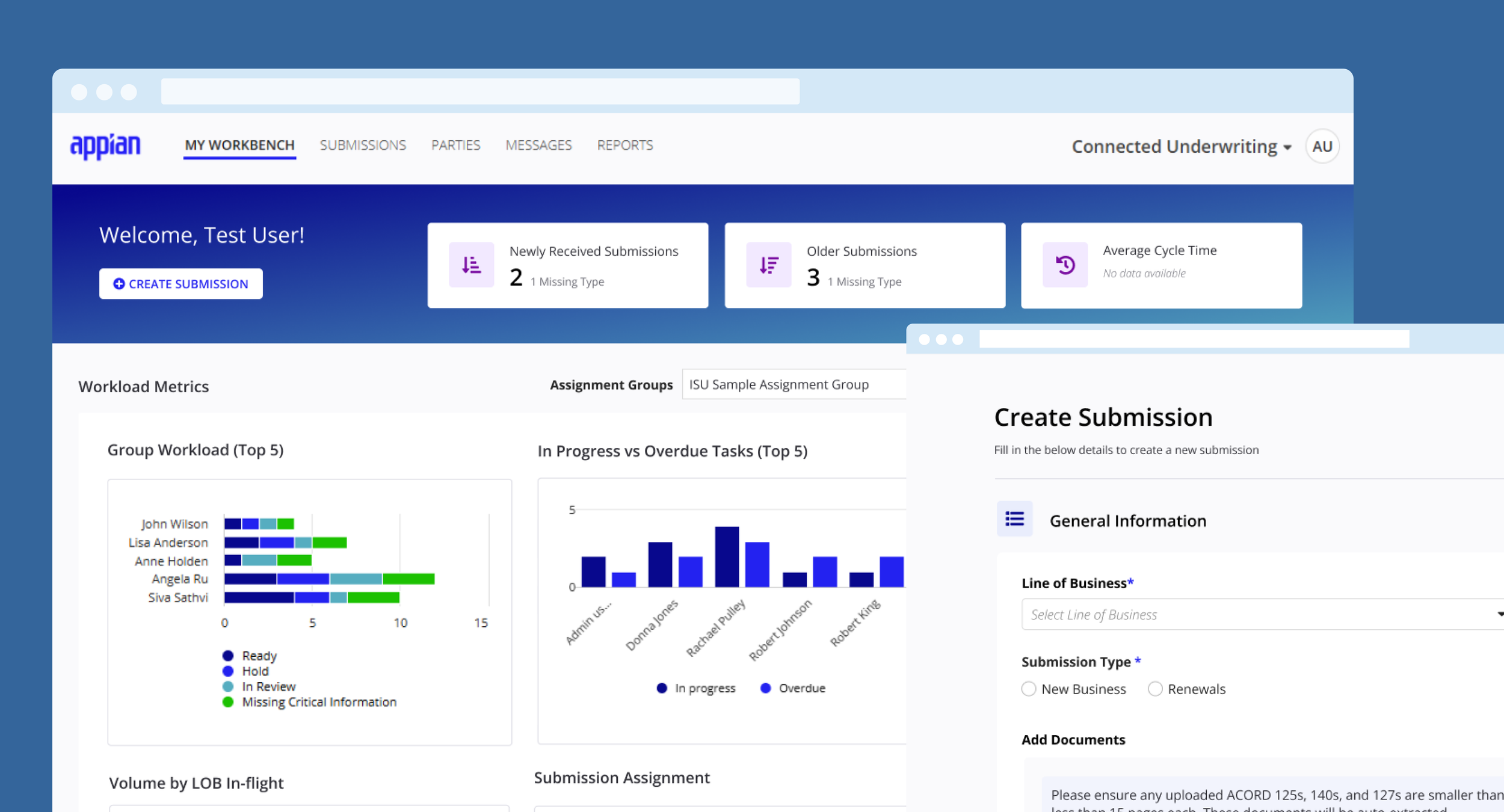
Solution providing a workbench for property & casualty underwriters to review insurance submissions and quickly approve or decline quoting a submission.
My Role
Lead designer working on an embedded team with Engineering, Quality, and Product. This is an ongoing product and through it’s lifecycle, I have managed 4 different UXDs on this.
Timeline
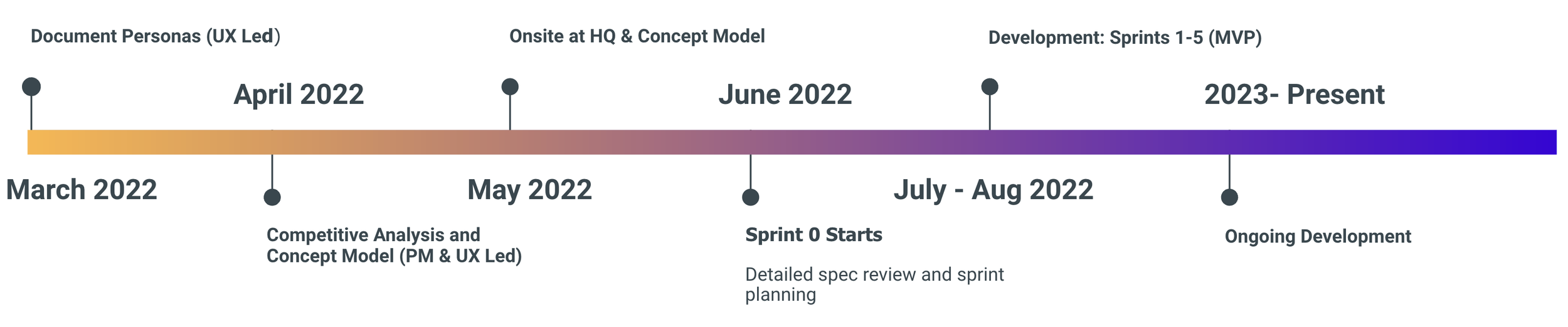
The first iteration of this took about 6 months from concept to final design. This included the discovery and research phase where I was the only designer. Connected Underwriting was first released in Sept 2021 and has gone through 3 subsequent releases. Detailed release notes can be found here.
Business Opportunity
Currently, the underwriter’s workflow is a manual labor intensive process of triaging and evaluating submissions from brokers. The market for underwriting solutions is fragmented with COTS solutions, other low code platforms and custom development, with no clear leader.
This was a clear opportunity for Appian to automate the intake process and increase submission clearance efficiency for commercial property & casualty (P&C).
Business Impact
Generated $3 million in ACV
Product gained recognition by Gartner and Forrester
Ranked as a “Major Player” by IDC’s MarketScape on Worldwide P&C Intelligent Underwriting Workbench Applications for 4 consecutive years
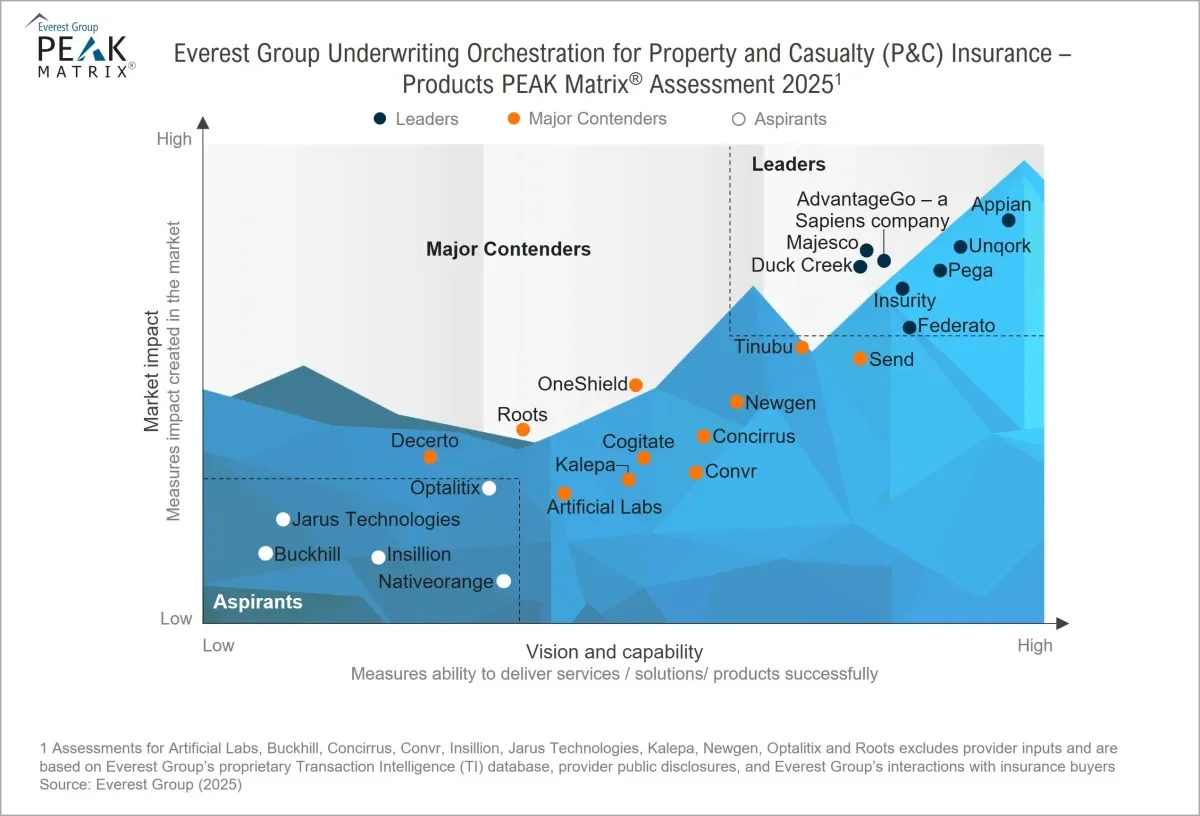
Recognized as a top leader in the November 2025 Everest Underwriting Report
The Design Approach: Discovery Phase
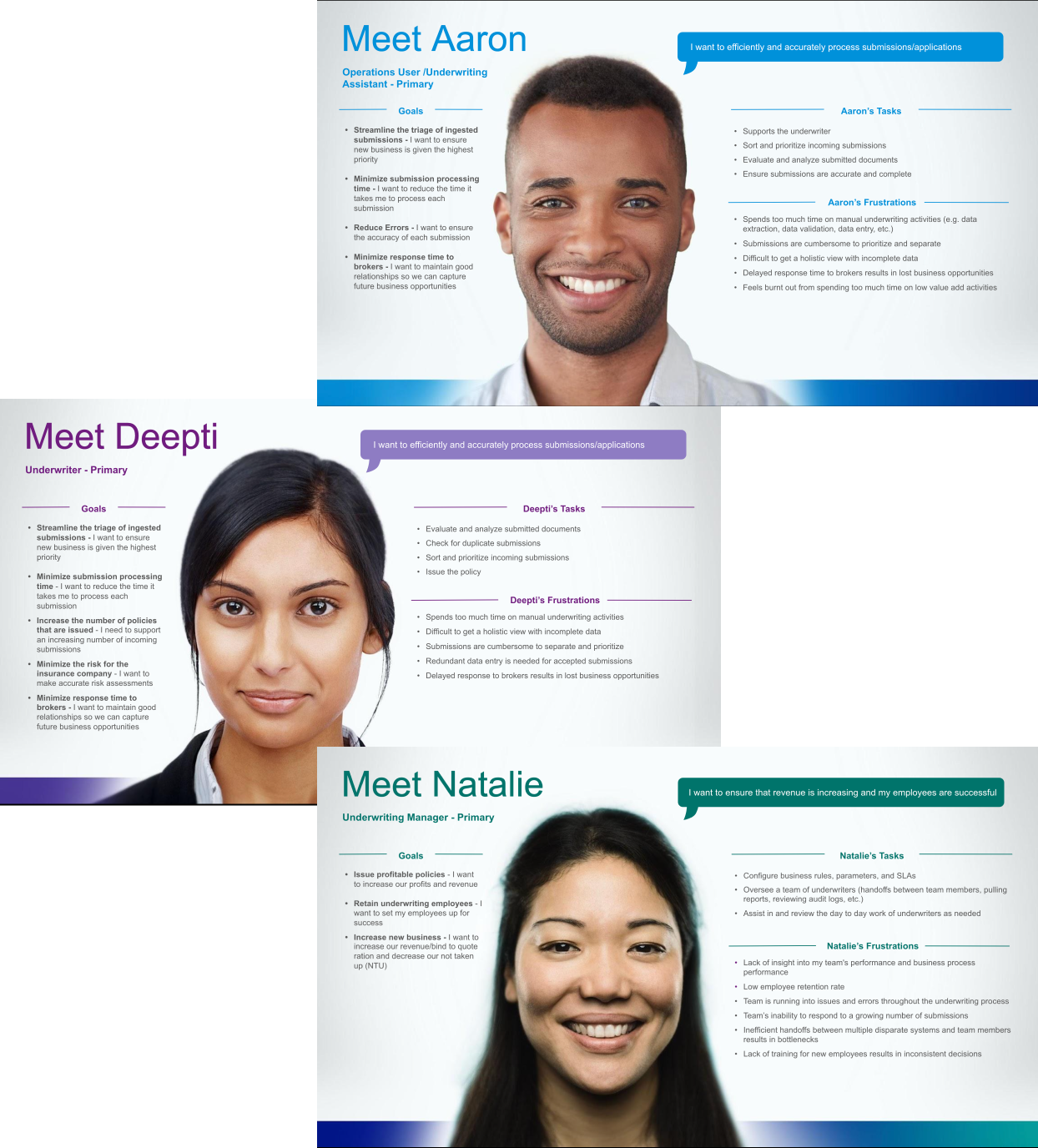
Discovery: Document Personas
How did these feed into the product’s design?
I facilitated a series of virtual persona workshops to align our cross-functional team (Product, UX, and key stakeholders) on the target users for our MVP and future solution expansions. For the MVP, we identified underwriters as our primary users, with plans to extend the solution to additional roles (brokers, managers, etc.) in later releases.
These sessions with our insurance SMEs provided our product team with valuable insights into the underwriting domain. They also enabled the team to establish clear boundaries for our solution’s scope. Given the widespread use of established policy administration systems like Duck Creek and Guidewire in the industry, we decided to focus our solution on the underwriting decision process, stopping short of policy issuance. This strategic choice allowed us to avoid direct competition with these industry giants and instead deliver a complementary solution tailored to underwriters' needs (Guidewire is actually one of our partners now!)
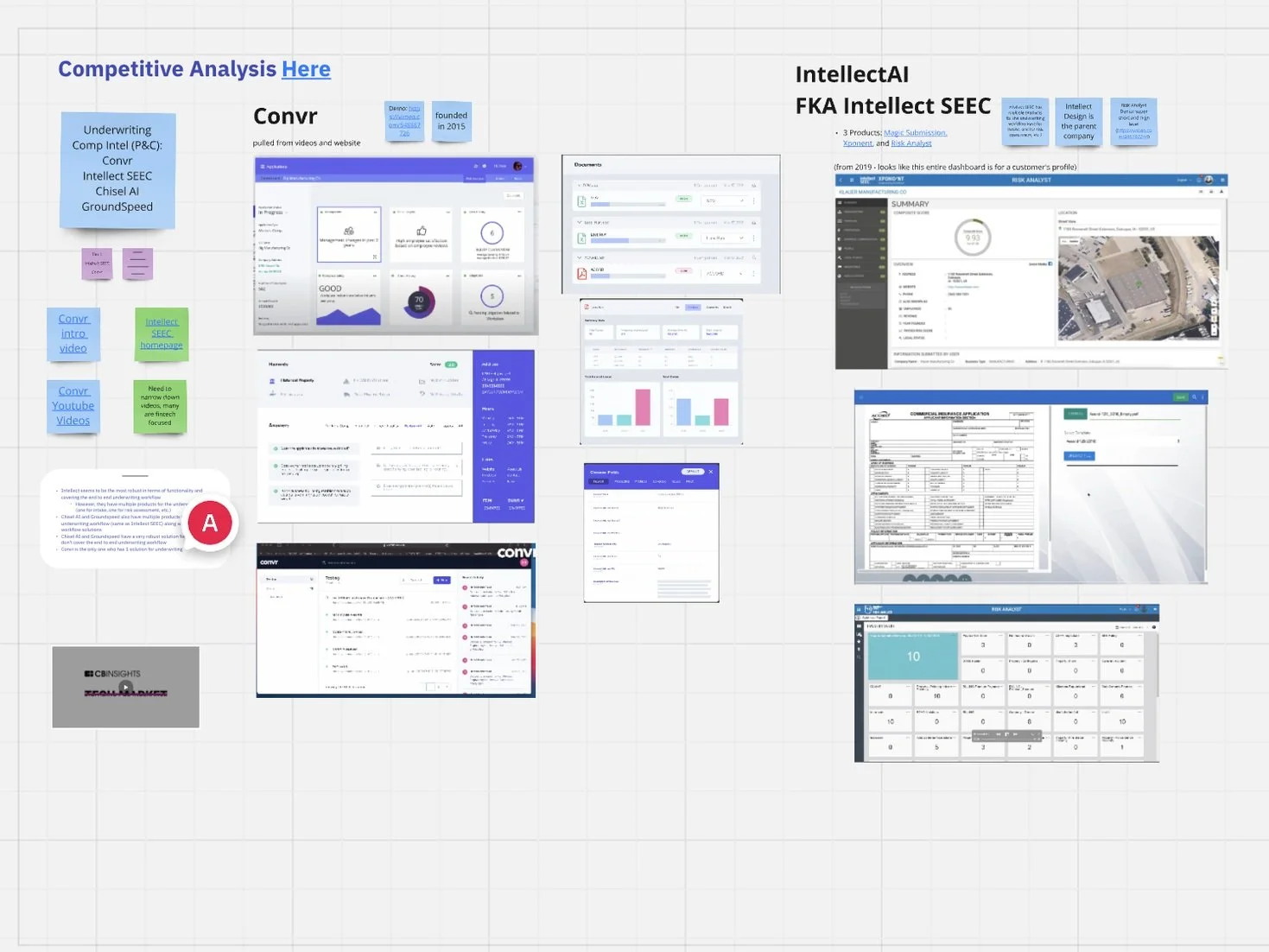
Discovery: Competitive Analysis
How did these feed into the product’s design?
Our competitive analysis revealed that much of the complexity in P&C insurance stems from extracting data from highly unstandardized Excel spreadsheets. This lack of standardization makes it extremely challenging to train AI models to extract data points accurately. Additionally, we discovered that no other released product in the market offered native AI capabilities. Leveraging Appian’s native AI capabilities, we integrated Intelligent Document Processing (IDP) into our out-of-the-box solution, positioning it as a significant differentiator and selling point.
We also observed that the insurance industry is not traditionally focused on UX/UI. Many competitor screenshots demonstrated outdated visual design reminiscent of the 1980s. This analysis not only emphasized the opportunity to innovate through modern visual design but also helped us define baseline requirements for MVP, identifying must-have and should-have features to prioritize.
Designing the Solution
Complex Workflows
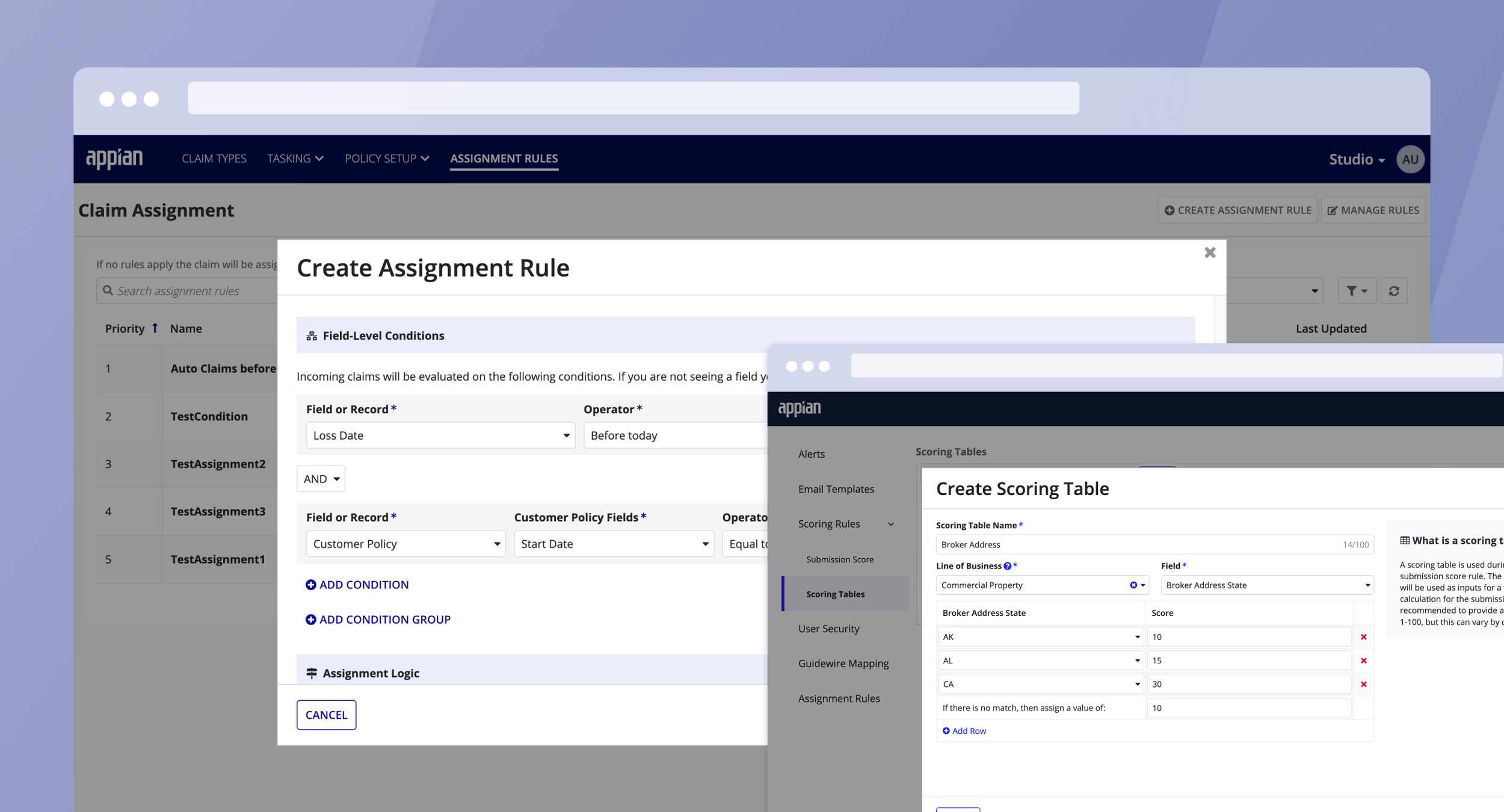
In the realm of P&C insurance, our product stands out for its ability to accommodate highly complex workflows, such as intelligent document processing, priority scoring, and auto assignment, offering unparalleled flexibility. Users can tailor the system to meet their unique requirements, a testament to the product's versatility and advanced design.
-
We are the only offering in the insurance market (as of 2023), and within Appian, that comes equipped with out-of-the-box (OOTB) native Intelligent Document Processing (IDP) capabilities. This pioneering aspect of our product presented a unique set of challenges, as there were no existing benchmarks or prior examples to guide our design decisions. As with anything that paves the way, lessons were learned - the biggest of this is that we should of done this feature as an add on (meaning that this feature could easily be added on or stripped out depending on the customer). Recognizing this, we have plans to adapt this feature into a more modular and flexible add-on in our future roadmap.
Collaboration with the separate IDP team at Appian introduced additional hurdles, given their independent control over the IDP's functionality and user experience. Our team had to devise creative workarounds to overcome these limitations, all while advocating for our enhancements to be prioritized on the IDP team's roadmap. -
The design of the priority scoring module required a delicate balance. It had to be easy to use yet flexible, allowing underwriting managers to customize scoring tables and rules. This balance was critical to ensure the module's ease of use to typical business users without overcomplicating the user interface or inflating the development effort without a clear use case. We ended up going with a single variable approach that was simple enough to manipulate but also flexible enough for our consulting teams to extend during actual implementation.
-
Auto assignment was another layer of complexity - I designed this modular component that is leveraged on multiple products at Appian. This feature allows work items to be automatically routed and assigned based on configured rules and conditions. I have a whole case study dedicated to this feature if you’d like to learn more.
Designing for APIs
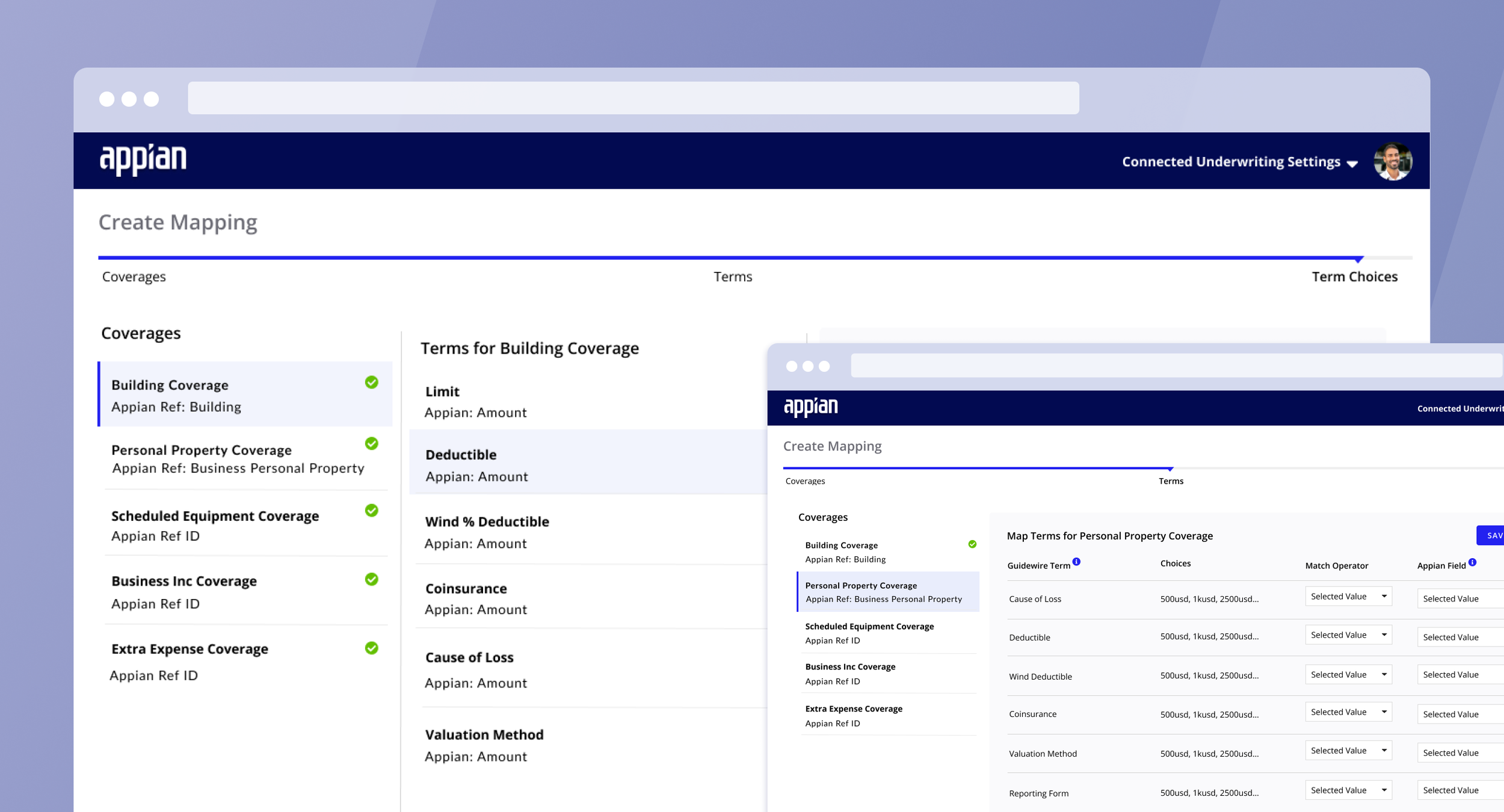
Our integration with external systems, particularly Guidewire, posed another layer of complexity. The design needed to not only facilitate seamless data flow between systems but also maintain adaptability for various customer environments. The absence of a standardized data model in Guidewire necessitated a flexible configuration tool within our platform, enabling users to map data between the two systems efficiently. As part of our Guidewire integration, a lot of data had to be remapped where everything required in Guidewire to generate a policy has to also exist in Appian. This resulted in retroactively redesigning some of these UIs and the logic and then determining which pieces of data from Guidewire are relevant to the underwriter and how best to surface it on our workbench.
Integrating AI Capabilities
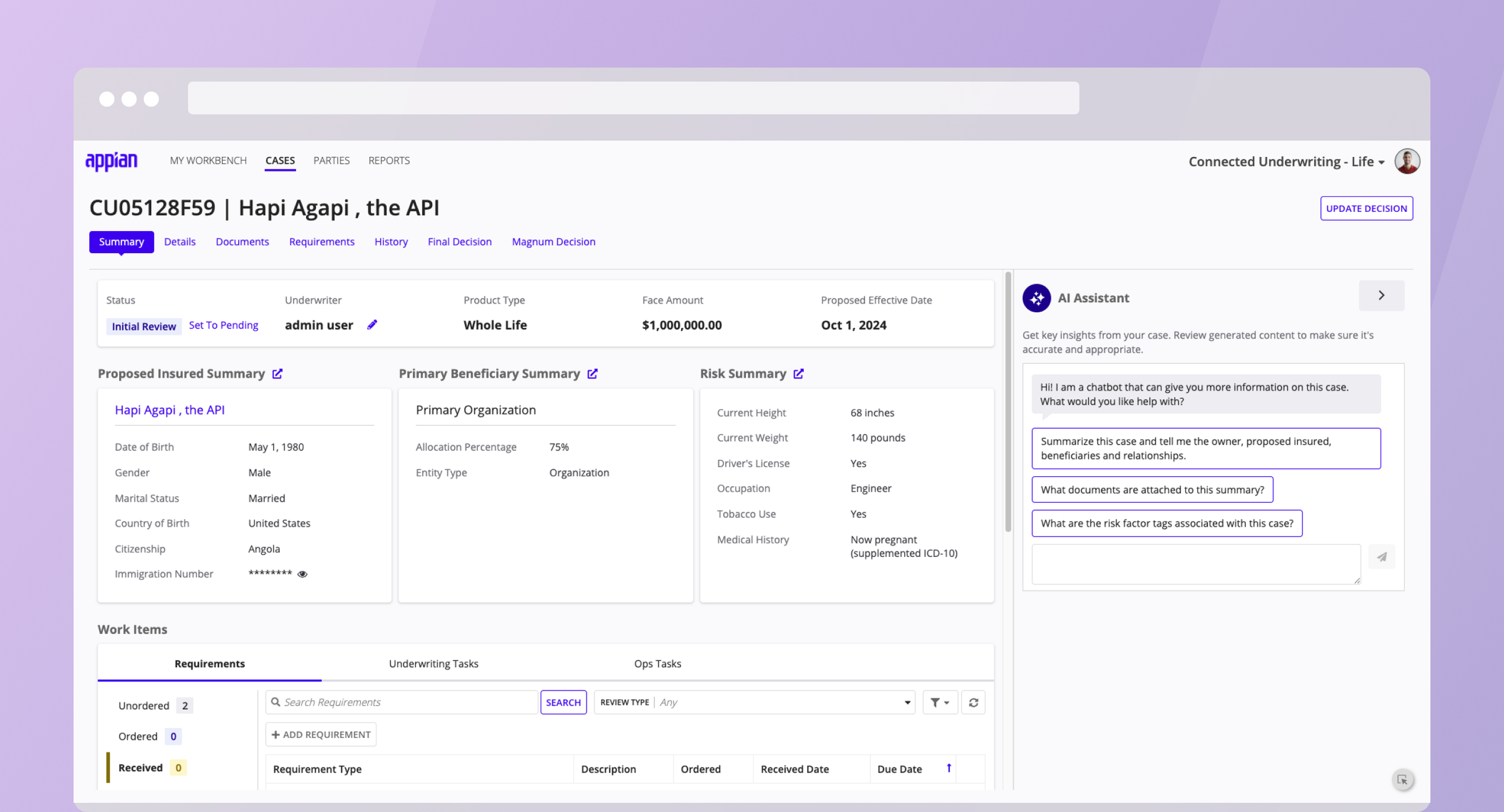
In response to the surge in generative AI technologies in 2023, I collaborated with my Product Manager to seamlessly integrate AI functionalities into our platform. I designed and shipped 2 features; one that summarizes long message threads using an OpenAI integration and another that enables underwriters to interact with conversational AI to get quick insights (essentially a chatbot).
Reflections & Next Steps
This product boasts one of the strongest sales pipelines within Appian’s insurance business unit. It is currently being implemented at an insurance carrier in Australia and another in the United States. The Australian implementation, now in its second release, has seen significant success. However, one major piece of feedback we received was that the out-of-the-box AI capabilities were too U.S.-centric, as our models had been trained primarily on U.S. ACORD forms. In response, we updated the framework to simplify future extensions, making it more adaptable for international clients.
We are now in maintenance mode while actively developing new features. These include additional integrations to pull in third-party data and further expansions of our AI capabilities, ensuring the product continues to meet the evolving needs of our global client base.